

The standard PayPay credit card earns 1% back on card purchases and up to 1.5% through PayPay Credit when you meet monthly spending conditions.
Most guides about the PayPay card focus on how to apply. Almost none of them talk about whether the card is worth applying for in the first place, especially if you are a foreign resident who does not already have spending habits locked inside the Yahoo/SoftBank ecosystem.
This one is written for expats and long-term residents in Japan who already use the PayPay app for QR payments and are weighing whether to pair it with a PayPay-branded credit card or go another direction entirely.
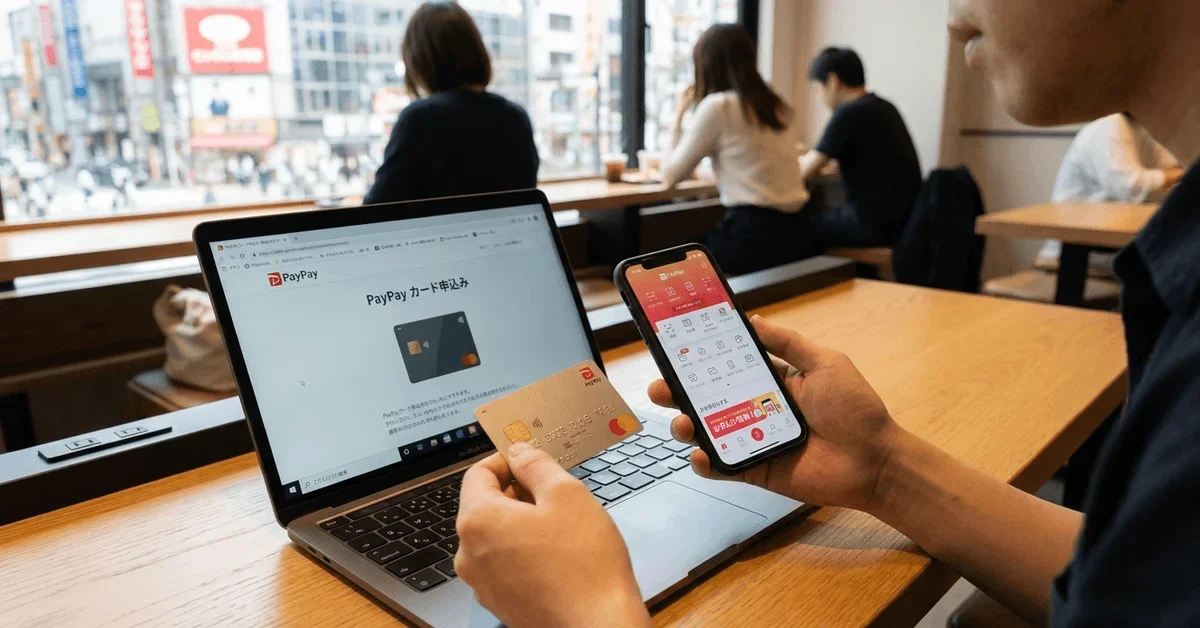
PayPay Card Reward Rates Explained for 2026
The reward structure on the PayPay card is split into tiers, and understanding which tier applies to you matters more than the marketing number on the landing page.
Base Rate vs. Conditional Rate
A standard PayPay card purchase earns 1% in PayPay Points. That rate applies when you swipe or tap the card at a store, or use it online.
But the number most people fixate on is 1.5%, which requires setting up PayPay Credit (the deferred payment option through the app) and then hitting two conditions every month: 30 separate transactions and ¥100,000 in total spending.
Miss either threshold, and you drop back to 1%. Hitting 30 transactions is harder than it sounds if your rent, utilities, and subscriptions are paid through other channels.
What Changed on the PayPay Card Gold
The PayPay Card Gold costs ¥11,000 per year. Until mid-2026, Gold cardholders received a flat +0.5% on top of whatever rate they qualified for, pushing the earn rate to 2% or higher for heavy spenders.
That bonus was eliminated and replaced with a milestone reward: spend ¥1,000,000 or more in a 12-month period, and receive 11,000 PayPay Points back, effectively covering the annual fee.
I would skip the PayPay Card Gold for most foreign residents because the ¥1,000,000 annual spending threshold works out to about ¥83,000 per month on that single card. That is reachable. But if you miss it, you are paying ¥11,000 for a card returning 1% when a free Rakuten Card offers the same rate.
Eligibility and Documents for Foreign Applicants
The application page is entirely in Japanese, and the eligibility rules carry some nuance that the raw bullet-point checklists online tend to gloss over.
Residence Card Validity and the Six-Month Rule
Card issuers in Japan use CIC, the country's primary credit bureau, for screening. A data point that catches foreign applicants off guard: residence card validity matters as much as income.
Japanese credit card issuers generally want at least six months remaining on a residence card at the time of application.
For the PayPay card specifically, applicants need:
- Japanese residency with a valid local address
- A Japanese mobile phone number (SMS verification is required)
- A residence card, My Number card, or Japanese driver's license for identity verification
- Age 18 or older (high school students are excluded)
A well-documented case from early 2026 involved an IT professional in Tokyo earning ¥7.5 million annually who was rejected twice because his card had only 10 months of validity left. After renewing to a three-year visa, approval came within two weeks.
The Credit History Gap Problem
Foreign residents who have never held a Japanese credit card or loan face a different obstacle: a blank CIC record. No history looks the same as bad history to the screening algorithm.
Some applicants work around this by starting with a deposit-backed card like the J-Trust Card (which sets your credit limit to your deposit amount) or applying at an EPOS Card Center inside a Marui department store, where in-person screening tends to be more forgiving toward first-time foreign applicants.
Step-by-Step: Applying for a PayPay Card Online
The process itself is quick once documents are ready. Most applicants report receiving a decision within a few business days. The card is numberless, so approved applicants can start using it digitally in the PayPay app before the physical card arrives by mail.
Gather Documents and Check Your Residence Card Dates
Make sure your residence card has more than six months of validity remaining. Prepare a clear photo or scan of both sides. A blurry upload is one of the most common reasons applications stall.
Go Through the Official Application Page
Start through the PayPay app or go directly to paypay-card.co.jp. The form asks for your name (in katakana and kanji if applicable), address, date of birth, employment details, and annual income. Every field is in Japanese.
Google Translate's camera mode or a browser with auto-translate can help, but double-check translated field labels before submitting.
One typo in an address field, even something as small as a missing building number, has been reported to cause rejections. The system cross-references your submitted address against your residence card.
Upload Identity Documents
The site will prompt a photo upload of your residence card or other accepted ID. Lighting and image clarity matter. If the upload is rejected, expect a delay of several business days before you can resubmit.
Wait for Screening and Activation
Screening usually takes a few days. Approval or rejection arrives via email or app notification, often in Japanese.
If approved, a virtual card number appears in the PayPay app immediately. The physical card follows by mail, and activation happens inside the app.
Some applicants receive a follow-up phone call during screening. This call is in Japanese, so having a translation app ready or asking a Japanese-speaking friend to assist is worth planning for in advance.
PayPay Card vs. Alternatives for Foreign Residents
The PayPay card makes sense for people who are already deeply embedded in the PayPay payment ecosystem. But "I use PayPay at convenience stores" and "PayPay is my primary spending channel" are very different statements.
| Feature | PayPay Card | Rakuten Card | EPOS Card |
|---|---|---|---|
| Annual Fee | Free | Free | Free |
| Base Reward Rate | 1% (PayPay Points) | 1% (Rakuten Points) | 0.5% (EPOS Points) |
| Conditional Higher Rate | 1.5% (30 transactions + ¥100,000/month) | 1.5% at convenience stores via Rakuten Pay | N/A |
| Application Language | Japanese only | Partial English support | English at Marui in-store |
| Foreigner Approval Reputation | Moderate | High | High |
The Rakuten Card's 1.5% rate through Rakuten Pay at convenience stores requires zero monthly thresholds. EPOS has lower rewards but same-day in-store approval at Marui locations, which removes the uncertainty entirely.
I think the Rakuten Card is a stronger first card for most foreign residents in Japan because its application flow has partial English support and its 1% base rate matches PayPay without requiring 30 monthly transactions to unlock better tiers.
Mistakes That Sink PayPay Card Applications
Rejections are frustrating, and re-applying too quickly makes things worse. CIC records log application inquiries, and multiple rejections in a short period (the so-called "six-month rejection trap") reduce your odds each time.
Common errors that trip up foreign applicants:
- Applying with fewer than six months left on a residence card. Renew first, then apply.
- Listing a non-Japanese phone number. SMS verification requires a domestic number.
- Having zero CIC history. A debit card or prepaid card through PayPay or another provider does not build CIC credit. Only credit products do.
- Submitting during the first three months of a new job. Issuers read employment stability from your tenure, not just your salary number.
The safest approach for a first-time applicant is to wait until a job has been held for at least three months, a residence card has 12+ months of validity, and no other credit applications have been filed in the previous six months.
When the PayPay Card Earns Its Slot in a Wallet
The card becomes genuinely useful for people who already spend ¥100,000 or more per month through PayPay QR payments and can consistently hit 30 transactions.
It also has a specific edge for Yahoo! Shopping and LOHACO users, where PayPay Points stack with platform-specific promotions and can push earn rates well above 5% during campaign periods. If you shop heavily through those platforms, the PayPay card is hard to beat.
For everyone else, the base 1% rate is nothing special. A Rakuten Card tied to Rakuten Pay at a 7-Eleven earns more per swipe with less friction.
Questions People Ask About PayPay Credit Card Applications
These are the questions that come up most often from foreign residents thinking about this card.
- Q: Can tourists apply for a PayPay credit card? No. The PayPay card requires Japanese residency, a domestic address, and a local phone number. Tourists on short-stay visas (90 days or fewer) are not eligible. The PayPay app can be used by tourists for QR payments, but the credit card is a separate product entirely.
- Q: How long does PayPay card approval take for foreigners? Screening typically runs two to five business days. If a follow-up phone call is required, add a few more days. Digital card details appear in the app upon approval, so there is no waiting for the physical card to start shopping online.
- Q: Is a Japanese bank account required to apply? The application form asks for a bank account for monthly payments. A Japan Post Bank account or any major Japanese bank account works. Online banks like Rakuten Bank or SBI Sumishin are also accepted. Foreign bank accounts are not eligible for autopay setup.
Conclusion
The PayPay credit card fits a specific kind of user in Japan: someone living inside the PayPay and Yahoo ecosystem daily.
For foreign residents still figuring out which payment rails to commit to, a no-annual-fee card with lighter conditions might serve the first year better.
The earn-rate math only favors PayPay once your spending is concentrated enough to unlock the conditional tiers. Take the time to compare before locking into a single ecosystem.